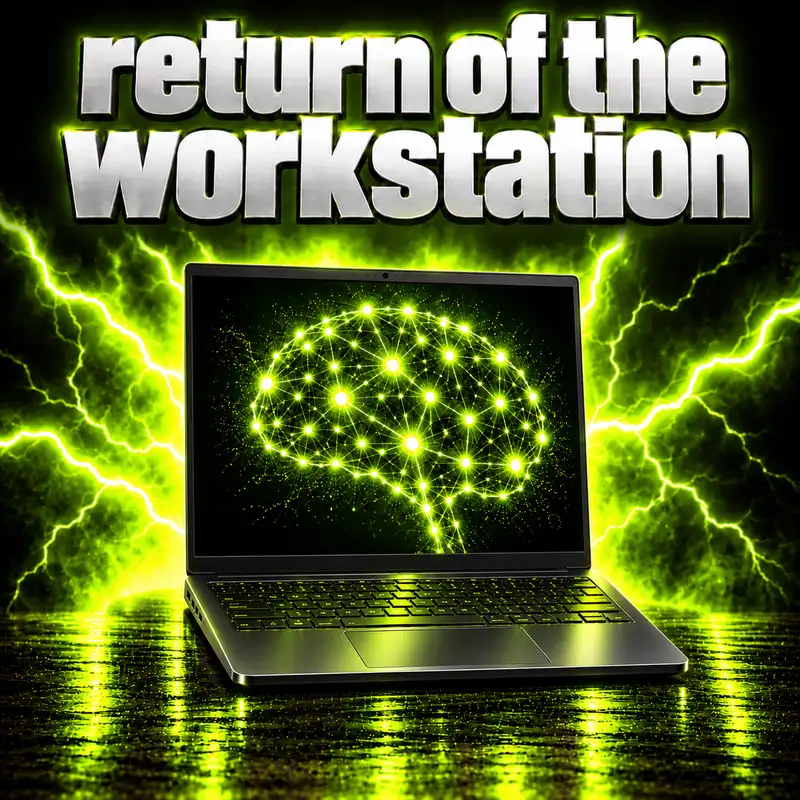
the localhost:0008 | return of the workstation
Download MP3Linus Tech Tips asked who on
earth buys a $6,000 AI laptop?
And meanwhile, in my house, I
have a machine with two graphics
cards that never turns off.
AI cloud keeps getting cheaper, and AI
hardware keeps getting more expensive,
and somehow the workstation is back.
Chauncey's off this week Scott
Slater is joining us from New
York, and this is the Local Host.
Frankcx: Welcome everyone.
We are back.
We took last week off, and if you
notice from our five pictures,
we've got a little bit different.
It's kinda like Sesame Street.
One of these faces is not, the
same, but we've, replaced Scott or,
Chauncey Larson with Scott Slater.
Robert: Permanently?
Frankcx: welcome back.
Robert: permanently
Frankcx: hey, let's first do
a little bit around the horn.
I think, Maybe almost in the round
the horn it would be like, where
have you been in the last week?
I have not been anywhere.
I've been, sitting here watching
sadly, the Seattle Seahawks lose.
Sam Darnold better figure out how
to stop throwing interceptions,
but I think he feels good.
Like, it feels like an easy game
this week going up against the 6
and 0 Kansas City Chiefs in Seattle.
but Canine is back into Seattle,
so we'll see how that game goes.
but hey, let's go around the horn.
Neil, I think you've been traveling,
so maybe, give an introduction
and tell us where you've been.
Neil: Ray.
Great to see everyone again.
Neil Mysak, disclosing that I'm a
member of Microsoft Surface Engineering.
The last week, I went to Chicago for
a Surface Laptop Ultra launch event.
great success.
Showed local coding, live on the device.
on my way from Chicago to Arizona,
stress tested the power of Laptop
Ultra, actually built an offline
PowerPoint generator, and then shared
that at the ASU Agentic AI Summit.
will.i.am made a guest appearance, which
I'll share more on throughout the show.
but
Robert: Wow
Neil: Chicago, and
Phoenix in the last week.
Frankcx: Welcome back
Jacob: How do we keep up?
Frankcx: Yeah, it's good to have you.
Hey, Robert,
Robert: I'm in the middle
of… You can see though now
my office is put back together,
different pink color on the wall.
We're in the middle of construction.
You might hear, a patio stone
cutter in the background, but,
hopefully AI Will keep that out.
And as soon as we're done here, I
won't dox myself 'cause this will be--
I'll be home by the time this airs,
but I'm on my way to Columbus, to go
see our son play soccer this weekend.
Maybe take in a Columbus Blue
Jackets game while we're there,
and, looking forward to it.
Frankcx: the Ohio State University?
Robert: it, happens to be there, yes.
I won't be there, but yes
Frankcx: He's… Yeah, my
Jacob: Will you tell us the exact
address you'll be at, Robert?
Frankcx: he always wanted me to dot
the I because he was a Ohio native,
but I never got the chance to do
that.
Let my dad down,
Robert: sorry
Frankcx: Speaking of
euphoniums and tubas, Jacob
Jacob: How's it going, everyone?
last week we didn't have the pod, but, I
wasn't on because I was in San Francisco
at a Best Buy in downtown San Francisco
with, folks like co-founder of NVIDIA,
folks like the founder of OpenClaw,
Peter, folks like the founder of Comfy
UI, which we showed on stage, Microsoft
showed on stage a couple weeks ago.
and about 400 people buying
their first RTX Spark devices.
Yes, which was awesome
Frankcx: other OEMs too?
Jacob: this is a chance on this podcast
to say that I don't believe any of the
purchases were Surface Laptop Ultras
because, that specific location did not
assort Surface Laptop Ultras in person.
Frankcx: transparency
Jacob: sales online, tons of excitement
about the platform, but, I was the
lone representative for Microsoft
there to, to help kinda connect
the dots and, and be a part of it,
Robert: keeping track, that
was Jacob's third low-key
brag already on this podcast.
Just…
Frankcx: Well, Neil worked in Neil
I Am, or Neil I Am, Will.i.am.
Neil: like that.
My new
Jacob: I feel I am
Frankcx: You are a DJ.
Is that your DJ name?
Neil: no, I go with Neil Nebula.
and I can share my, recent Redmond
debut in the Microsoft tree houses,
Frankcx: Ooh,
Neil: recently connected as well, so
Frankcx: I will cut in the
video if you have some to share.
I'll put it in the pod
right here, so awesome.
All right, well, Chauncey
is out this week.
I think he's down at a wedding or
some other event down in Mexico.
But we are honored to
have Scott Slater here.
Scott joins us from
New York, in the house.
Scott's old school, Microsoft
Surface and Microsoft's, we call
it an M2, like he's a sales leader.
so Scott, I'll turn it over
to you to kinda introduce
yourself and how are you doing?
Scott Slater: Yeah, and I'll say
the honor's all mine to be with you
fine gentlemen, and I wasn't sure
where you were starting when you
started sharing I thought it was old.
Frankcx: old
Scott Slater: yeah,
pleasure to join you all.
Looking forward to having
a fun conversation.
I'm one of the leaders in Microsoft's
Windows specialist organization.
no great stories this week, but I was
in and out of New York City meeting
with different large customers,
which is generally how I spend my
weeks, meeting from customer to
customer across different industries
Frankcx: Scott, I'm gonna open it up.
We're changing the format a little bit.
I've got these top questions of the
week that I'd love to be able to ask,
and as kind of the host week, my first
question is actually to Scott, because
it sounds like making that trip into
New York City, meeting with those
valued customers at Microsoft, what
are customers actually asking about
in AI and specifically AI on device?
I mean, sounds like you're on the
Windows side now, so Windows is obviously
more than just AI on device, but,
coming from the Surface side, it'd be
interesting to get your perspective as
to how customers are thinking about it.
Scott Slater: Yeah, it's
a good question, Frank.
I think, the conversation flips
at some point with customers.
I think some customers start
talking about the hardware.
They may ask about the chip, the silicone.
They may ask what an NPU is.
They may ask about memory and tops
and GPUs and, and after getting a
little bit into that conversation,
it kinda changes to, you know, can
I, can I use the devices I have today
or do I need to get new devices?
And that's kinda where
the conversation flips.
And then at some point the conversation
goes from there to, where is my data
and is it secure as I'm running these
AI workloads on these new AI PCs?
And then at some point it shifts from
there to like, does everybody need
this in my environment or do only
some people need it in my environment?
And so
it's interesting how these
conversations are going with customers.
But I usually I see it starting with
like understanding about today's new
hardware and then it quickly shifts
to who needs this and can I do this on
what I have or do I need something new?
Frankcx: I find that an interesting
question because, as I was watching a lot
of the, reviews of the RTX Spark, device,
and whether that's a Surface Laptop Ultra
or the other OEMs that are selling those
devices, one of them that came to mind
was Linus Tech Tips, a guy that's been
in the internet for quite some time.
He's got quite a bit of experience
out there, sits up in Vancouver,
watching over all of this.
But his actual take on it was like, who on
earth would spend $6,000 for an AI laptop
when you can through a tool like Tailscale
or another tool that allows you to
tunnel into an AI device, into your home?
And I'll, I'll say that firstfor- and
foremost, that's honestly probably
the way that I use AI the most today.
I have a device that's literally
right behind me, AI models.
I'll talk a little bit about this,
Ride Edge app that I've developed,
but, that's the way I use it.
I use my phone, in some ways to Tailscale,
, a nice portal and a nice kind of tunnel
application that cr- creates a secure
loca- secure tunnel into the device.
So I would wonder, like, why
would people even buy a laptop?
But Jacob, I know that you were
at the Best Buy, and you were
watching people walk out the
door with a bunch of AI laptops.
You know, what was the reason
that they were doing that?
Jacob: Yeah, I mean, first of all,
I, I think, your perspective, Frank,
is mostly because you're using
the hardware you have available.
Almost to, to, to Scott's point
earlier, like customers are asking
like, "Do I need to buy something new
or can I use what I already have?"
Like, if you've got dual 3090s, like
you're already set up really well.
Like that's gonna cost you… Like
that whole setup is probably 10
grand on the open market these days
with the price of graphics cards.
so I would say that yes, you're
kind of an edge case in that you're
already set up well, and you don't
have one of these, from what I know,
Laptop Ultras or RTX Spark devices yet
Frankcx: one, but nobody
Robert: Get in line
Frankcx: as
Jacob: Yeah
Frankcx: influencer, now
I'm not as big as, Neil I am
Jacob: but what I will say is that
customers are just looking for devices
that match their needs in my perspective.
And so the folks that walked out of
that Best Buy, they were excited.
it was a little bit more on the
consumer side where folks are looking
for their AI work, they're looking
for their gaming work, they're
looking for their development work.
They're-- Like some of them
were AI founders themselves.
I got pitched on a number of different,
startups that week on like, "Hey, do you
have access to the Microsoft socials?
Like you work in marketing. can you get
me connected with the right person here
or there?" I'm like: Okay, I'd love to
hear your idea, but let's chat about it.
But I think that users just want a
device that they can turn on, that
they can use, and by the way, a ton
of great announcements this week and
the last couple weeks from Microsoft
and other partners on how it's easier
than ever to just have local AI built
into the tools that you're using.
Robert: an RTX
Jacob: like GitHub Copilot
CLI, stuff like that.
Robert: device, laptop as a server,
or you can take it with you.
Now, look it, full disclosure, I
think we talked last podcast, do
I spend six grand on a laptop or
do I spend six grand on a patio?
I think by, if you hear the noise
You know, what my decision was.
And no, it's not very mobile.
but I… Look it, I love the idea
of going to Neal's Point, going on a
plane, going offline, and just grooving
for four or five hours on a flight.
That, dude, that to me is totally worth it
Scott Slater: know, I, I'll
Frankcx: Neil, I guess maybe
the… Oh, go ahead, Scott
Scott Slater: Yeah, I was just gonna
say, I, I think I, I really agree
with, with Jacob and Robert here.
I don't think… If you're trying
to save a few bucks on tokens,
I don- I think Linus is right.
You're, you're not
buying the device, right?
But, for, for builders, for creators,
they're, they're buying freedom, right?
Like, look, when you're running on a
meter, your behavior changes, right?
Like, if every try costs money,
you're gonna play it safe a little
more, but if you take that meter
away, you're gonna try weird ideas.
You're gonna run crazy tests overnight.
You're gonna try 10 things
versus one thing, right?
Running on a meter, are
more careful, right?
And what you want is, is to take that away
so you can drive the curiosity and, like,
Robert: More
Scott Slater: That, that's right.
You know?
And, and look, the people that are
the most curious, that don't have
that restriction and are the most
creative, those are the ones who
think of the next big things, I think
that's the big thing here, to enable
the freedom to get that outcome
Neil: Totally agree with that, Scott.
I was gonna say, there's been a
big push from enterprises around
token economics, and we're running
this workload in the cloud.
What facet of that workload can come
to the edge, and what does that,
correspond to in terms of an ROI
model over the cost of this device?
And additional value add is, what
is the cost of lost experimentation?
If I have a finite token budget and I
have my role specifically in scope, I'm
preserving those tokens to accelerate
what I need to accomplish, and I'm not
thinking about doing and achieving more.
So this notion of unmetered
intelligence, right, taking away that.
finite token limit not only helps
accelerate productivity, whether you're
35,000 feet in the air, on-site with
a client in an air-gapped environment,
but it also unlocks, the opportunity
to create tooling that wouldn't
be possible when you're operating
under just a fixed cap mindset
Scott Slater: know, Neil, I,
I had a developer say that exact
thing last week, and they wanted
the right to fail cheaply,
Neil: Mm.
Scott Slater: wanted the right to not
ask permission, and I think that's part
of why people want these devices where
they don't have to ask permission,
and the cloud doesn't give them that.
You know, in these big enterprise
companies, they need to ask
permission to have more tokens
Robert: if we wanna tie this back to
the original question to Scott about
what customers are saying and then the
token economics piece, I learned this
week through talking with customers the
amount of overspend that is happening in
the cloud, either due to token usage or
token cost, raw token cost, dwarfs the
increased price is for RAM or storage
or GPUs or anything in the hardware.
It absolutely dwarfs it.
So for some of us that are in the
Windows and PC game, we're like, "Oh
my God, the world's on fire." To these
guys, it's like, "Eh, it's a drop in
the bucket" for, for the potential
Jacob: Угу
Robert: could save.
It was a huge eye-opener
Frankcx: this is a question back to Scott
too, and I'd love other people's input
because it feels like everybody's doing
a little bit of vibe coding out there.
But Scott, as you look at, new sales
reps that you're hiring on and, bringing
into the fold, obviously different reps
have different skills of relationship
compared to technology background.
But with the vibe coding story that's out
there these days, what happens when every
seller can build software of their own and
be able to tell a story to their customers
to showcase the value of these devices?
I don't know if you've
started to see that.
Obviously, Robert works on your
team, so that might be one of your
example reps that, you have out
there that can showcase, like, I can
customize something to really sell the
customer on the story of what AI has.
But I'm wondering, do
you have a take on that?
Scott Slater: Yeah, I've thought
about that, and I think what worries
me a little bit is that, look, every
person, every seller can build today.
They can build apps, dashboards,
trackers, automation, right?
Building isn't the hard part anymore.
That's the easy part now.
But keeping something running and,
that's a hard thing to do, or knowing
which problem you should actually
build something for, I think that's the
harder part today, in my opinion, right?
The building part is easier and, and
I think what we're gonna see soon
is, like, thousands of these little
apps and dashboards and trackers
that one person owns or nobody owns.
And it means is IT's not owning this,
and I think that's a problem that's gonna
really raise up soon in all organizations
As all these things get built, they're not
necessarily solving for the right things
Neil: I have an ig-
Frankcx: for the rest of the team here,
like being able to customize something
that kind of specifically aims at
the customer's voice, if you've seen
value in that type of storytelling?
Neil: 100%.
I walk into every customer partner meeting
with a custom demo pack, and to Scott's
point, art of possible, doing my homework,
meeting with the reps that already know
that customer, doing my research online,
so that I can come prepared with a custom
artifact, functional local AI solution
in every customer meeting has been my
mindset for the last eight, nine months.
Keep in mind, I have an electrical
computer engineering background.
I hadn't touched code in 15 years, right?
And so the ability to now, again, create
these prototypes in my favorite language,
English, meet customers where they are
on their journey, extremely impactful.
I do wanna highlight the
inverse of that, though.
In a world where you can build
anything and creation is no longer
the bottleneck, choosing which
problems to solve, super important.
I met with a customer, and they had,
essentially a rogue experiment gone wrong.
Someone came up with the idea
of a brand-new ERP platform.
They consumed six figures in tokens, only
to find out that they had already licensed
a perfectly functional ERP platform.
So that's over 100 grand down the
drain on top of that time investment.
So again, when in a world where
you can build anything, make sure
you're building the right thing.
Avoid that, disaster scenario
of 100 grand in tokens down the
drain to build a duplicate system
Robert: And the, the other side to that
is say you have 1,000 things people
built, but they're built by 1,000
different people, and then what becomes
the standard for… I mean, everybody's
building something that they think
is awesome, but now we have like 100
different versions of something, and
nobody knows which is the, you know,
which is the blessed one and, and whatnot.
I had to build a customer
one-pager today, for one of our
OEMs and couldn't find anything.
Took a long while to do it, and the
first thought that came to my mind is,
"Oh, I should share this." And I'm like,
"No." I know what that's gonna create
is the problem of this proliferation,
and then the governance and ownership of
what you should or shouldn't be sharing
Frankcx: I'd love to turn this to
Jacob, because Jacob, you saying that
you stood in a Best Buy with a bunch
of influential people, but also watched
a lot of devices go out the door.
I'm reminded of, when I was at Build
one time and somebody came up and
literally bought a $4,000 Surface
laptop, and now I see that there
is a return of the workstation.
the workstation, I would say, once died.
we didn't see a value because people
were pushing so much up to Azure.
Laura, coworker of, Robert's and Neil's
in the past, or still Neil, she pointed
out, like, I spent a decade pushing
people to start using Azure in the
cloud, and not that Azure-- I think
the Azure numbers are still secure, but
we're starting to see people start to
think about a workstation again, like
the power of a super powerful device,
a device that can make money, for you.
So I'm wondering, Jacob, when people
were dishing out that much money…
Well, of course, everybody in San
Francisco's got unlimited cash flow.
Jacob: Not necessarily
Frankcx: I'm like, what
do you think about that?
Like, the return of the workstation?
Jacob: the first person that bought an
RTX Spark device in San Francisco, he was
on camera and shouted out to everyone,
like, essentially, so excited to use this
to build without limits and to be able to
not have to worry about my token costs and
also do some awesome gaming and stuff."
So he was going to build
his business around it.
What his business was, I have no clue,
Robert: to
Jacob: but he was gonna build his
business around this investment.
Robert: How long did it
Jacob: What's that?
Robert: that?
thought he
Jacob: you can look at the PCMag video.
Like, they've got an Instagram reel up.
They've probably got TikToks up
where it highlights what he said
when he was walking out of that.
But it was… Maybe I butchered it,
but it was something to that effect
They're like, "Oh, we wanna clap,"
but, "Oh, he keeps on going.
Oh, he keeps on going." It was like a
quasi interview question, and everyone was
cheering and clapping and it was exciting.
That was the type of sentiment that it
was kind of a hybrid of what Scott and
Robert and y- like what we were already
talking about that like kind of opens up
your ability to create, your ability to,
to not feel like you're compromised by the
amount of, tokens you have or even by like
the sovereignty of your data, like where
it's going, like what, what, you know,
what, who has access to your sensitive.
For a lot of these founders that
I talk to, like who has access
to their sensitive information?
and they're not just gonna use a
standard, you know, consumer, AI model
in the cloud for building their own
business that may be competing with
that cloud solution that already exists.
Frankcx: Jacob,
Jacob: And so that's
something interesting.
There are obviously enterprise versions
of these that have license agreements,
but it's still an interesting thing
like to think about that privacy
Frankcx: Well, I know that Jacob, you like
to make fun of me because I make reference
to some of the older technologies
that I've worked with, but it would be
that, you know, we watch that pendulum
Jacob: Got it, thanks
Frankcx: where we talk about going
from like a mainframe to a PC, and
I would argue like Lotus 1-2-3 was
probably like what caused a lot of
people to start buying a PC what is that
application that allowed them to do that?
I always name drop that I worked for
this company, Silicon Graphics, that
got put literally out of business by
Nvidia at the time by selling a $300
gaming card, that business caused
people to go from like a large device
to a small device again because of
this $300 gaming card and be able to do
things like Photoshop on your device.
But I would say like, what's that thing
that's really moving the needle or moving
the dial, you know, that causes people
to buy a workstation, like at $6,000?
Is it open weight models?
Is it agentic coding?
Like, you know, what are
you seeing out there?
And I guess for Neil and Robert
and Scott, as well, like what are
you guys seeing that is kind of
pushing people to have interest in
these workstation class devices?
Robert: you go first
Scott Slater: yeah, you have the honor.
So you go, then I'll go, 'cause I
think I'll have a different perspective
Robert: I think the open weight
models is the one that's getting
people hooked and interested, as
the first kind of step to this.
I think it goes back to, I don't
know who said it, but about
the, like, the unlimited, like,
limitless creativity, right?
I have the ability to do this without a
connection, without oversight, without
token spend, all of these kind of things.
I would love nothing more than
to have a AI workstation, just to
run everything I wanna do off of.
There's probably 80% of the things I don't
do right now is because I don't have AI
workstation sitting right here beside me.
there's a whole bunch of stuff I wanna
try out and do, but I'm not gonna burn
tokens to go, to go figure that out.
I'll wait till, the chains
come off, so to speak
Scott Slater: I'll add to that.
what I'm excited about is
what's going to happen, right?
Like, so I know we're talking
about on-device AI and, you
know, what's exciting there.
I think what the exciting part is the
stuff that users don't even notice, right?
And I think that's just gonna
continue to evolve, right?
So we know, like, now there's AI models
that make video calls better, right?
Or that can do live captions, or
you can search files faster, right?
Or stuff that can work when you're
30,000 feet on a plane with no
connectivity, and like, that's the
stuff that gets me real excited.
Like, don't get me wrong, I'm still
excited about local models and, you
know, I'm prepared to talk about local
models today, and I know we announced
a whole bunch, about a week ago, right?
Like MAI, which stands for
Microsoft AI, by the way.
Robert: Yeah
Scott Slater: A super creative
name that we came up with, right?
I'm really excited about that.
Like, the stuff that nobody knows and it's
just there that the new hardware enables.
And, new hardware plus, the models and the
apps that are tapping into those models.
I'll try not to talk a lot about Microsoft
products, but, the hybrid intelligence
stuff really I'm excited about, right?
'Cause the idea of that, that was
announced, is that a user wouldn't
know, Like, the hybrid intelligence
would decide if it's leveraging a
cloud model or a local model based
on some efficiency metric, right?
Like performance, latency, cost.
Like, that's really…
Robert: Yeah.
Scott Slater: Privacy.
Like, that's really interesting.
Like, if you don't need to know as
a user and you never notice it, but
you have the right hardware, right?
Frankcx: Yeah, Neil, I wonder, like,
when you're talking to customers, that
story that, Scott is, talking about
it is really starting to resonate
with a lot of our commercial or
enterprise-grade customers out there?
Neil: 100%.
we've been promoting local hybrid
intelligence, for years, and now that it's
coming essentially baked into the tools
customers already own, that barrier to
adopt hybrid intelligence has disappeared.
Before, you had to go out and
either buy or build a routing
mechanism, which frontier customers
are doing, but now we're meeting
them right where they are, right?
that auto-routing capability in
GitHub Copilot with HydroFusion,
absolute game changer.
I'll highlight on the topic of
unlimited creativity, I learned
during my time at ASU, will.i.am
is actually a professor there.
He has 200 students, in the creative
department, and NVIDIA gave him a grant.
All 200 of his students have a
Spark device, to tinker with, build
with throughout their semester.
Frankcx: Can I sit in on that course?
Neil: going back to school
myself to attend this one.
and so think about that, right?
Unlimited creativity for will.i.am
students throughout the semester,
essentially creating a digital twin
of their creative, persona, whether
they're, a musician, artist or more.
we've really just hit the tip of the
iceberg in terms of what's possible
when we bring unmetered intelligence,
and hybrid intelligence together,
unlocking a new era of computing
Scott Slater: So Neil
Jacob: I mean, you guys have
been doing this for a while.
Like, I remember Robert, Neil, you showed
me a demo two years ago of, essentially
deciding where that workload should go,
you know, whether it's cloud or it's not.
and I remember being blown away
by that, going like, "Okay."
And that took some effort to do.
Like, we would talk about, oh,
it's just some lines of code,
but, it took some effort to do.
You'd have to have the right
accounts, the right things, and,
having that built in is awesome.
And I know Robert, shameless plug for
the Surface IT Pro blog, but we've got,
a blog post that just landed this week.
it was actually authored by one
of our very own, so we've got a
thought leader here on this call.
Robert, you wanna talk at all about that?
Robert: how awkward.
Frankcx: How awkward.
Robert: listen, to your point, Jacob,
full disclosure, I was in Surface.
Now I'm in Windows.
Before I left, we wrote a hybrid
intelligence blog, waited till the
announcement came, so the people
knew what we were talking about
with hybrid intelligence, which
essentially now replaces unmetered
intelligence, in the nomenclature.
But it's all about, what
we've been talking about.
Lookit, it's all about what our blog
or what our podcast is about, and
just talks about it in those terms.
Frankcx: kinda hoping you'd
title it Super Intelligence,
Robert: Oh.
I did, but it did not make it past legal
There is another one coming
out, by the way, on, on device
economics as well that, I think
Frankcx: Definitely check
Robert: our audience will enjoy
Frankcx: blog that Robert put together.
Super insightful.
I want to turn the wheels a little bit.
we talk about this idea of the return
of the workstation, but I'm also
reminded of, what Satya has put out
there in the past in some of his blog
posts around keeping the intelligence.
You know, you shouldn't have to share
your own intelligence with a cloud model.
And I think, Scott, you made mention
of these new models from Microsoft,
like Microsoft AI, and what Mustafa
out there is doing with his big giant
team down in the Silicon Valley area.
beautiful office, by the way.
I got to visit once or
twice, and, pretty amazing.
But, by the way, they offer free food
down there, which they don't give
on the Microsoft campus, so I guess
that's a great in- incentive as to
Scott Slater: I think they
grow grapes on the rooftop also
Frankcx: Of course they do.
but one of the things that really
stands out to me is that new model
is now available in Azure as a
model that you could actually load
yourself on your expensive Azure
infrastructure, but it's all yours,
meaning, like, it's not trained.
It doesn't learn from, the
things that you share from it.
It's private into that space.
And I wonder, like, that seems
to be another reason to me,
like keeping the workstation and
keeping the data, into that space.
And I'm wondering even Jacob or
Neil or Robert or even Scott, like,
as you're talking to customers,
this idea of IP protection.
Like, I can't share that information,
with anybody outside of my own space.
And I also talk about this idea of
this second wave of AI, like these
customers that just couldn't take
part in the first wave because they
didn't want to share with Sam Altman
or Dario Amodei, you know, all of their
internal, you know, trade secrets.
But now with these new devices and, you
know, Microsoft artificial intelligence
models or having workstations that the
data stays on that device, if we're
starting to see some customers start
to think about that into that space.
Scott Slater: Yeah, I'll… Well,
I, I could start giving you just
a quick little thought on it.
I think it's important for us to
talk with customers about these new
local models that exist and how large
models, some of them are being shrunk,
to provide just as good capability
locally than on the cloud, right?
And, a lot of these models you'll
see have this word flash at the
end of the name of the model.
That's mean
that means that it's fast, it's
lightweight, it's built for
speed and cost, and It's not
intended to be the biggest model.
And, I like to, for customers
that don't understand this,
to give them some analogies.
So one that everybody understands
is, like, an image, right?
a full-resolution photo versus,
like, a compressed JPEG, right?
And I think most people understand that.
And for most people, you look at that
photo, you won't know the difference.
But if you zoom in on the compressed one,
it may be a little more blurry, right?
But for most people, the
compressed photo is good enough.
Or in music, it's like a master
studio file versus, a compressed
file for streaming, right?
For most people, you're not gonna
notice the difference when you're
driving in your car and you're
listening to it in your car.
But, maybe an audiophile audio
engineer, they'll know the
difference, but most people wouldn't.
And I think that's, a nice way to
compare, a cloud model that may have been
shrunk to now be a local supported model
Jacob: Yeah, I would just point out
that there's concern sometimes from
folks going, "Well, doesn't it lose some
precision when you compress it?" And while
yes, in theory it does, when you quantum
model down, it does lose some precision.
But nowadays, even with frontier
models, all of the work that
folks are doing should be checked.
And honestly, it's often
checked by another model.
Like that's built into
most workflows nowadays.
And so you have one model that's shrunk
down that's doing some great work,
heavy lifting, and all of that work
should be checked by another model.
It might be another version of
that same model or a different one
that's tuned for different things.
And so together, those two smaller
models make an output that's
better than even one larger model
could do, which is kind of cool.
Scott Slater: models?
Okay.
Frankcx: I think that's pretty common
these days in writing applications.
I'm writing an application right now
for a partner company of ours that
does meeting room applications, and
I'm writing it with Codex, but I'm
using Claude to do all of the check,
so that they balance each other.
And then even this last week, I noticed
that, Google released Argon, and so
I've been using Argon to be almost
a third-party reviewer because there
are blind spots that these AIs create.
And so I asked Argon to go through
And do a full scrub of the code base.
And sure enough, it came up
with a couple, blind spots that
Claude and Codex, didn't see.
so it's amazing to watch, how you
can drive application development
by trusting three agentic
coding agents to drive that, so
Jacob: And by the way, I've got
three, different models running
on one device next to me, an
RTX Spark Surface Laptop Ultra.
they're all about f- 20 to 40 billion
parameter models all running at
the same time in the same workflow.
So th- like that, that
is totally possible and
Robert: by the way.
Frankcx: Four, yeah,
Robert: low-key brags
Frankcx: yeah
Jacob: Hey, we're here to
talk about local AI, you
Robert: ran my first,
Jacob: as well, talk
about what we're doing
Robert: model, a 32 billion
Frankcx: Oh
Robert: MoE two-bit model.
and I was Very impressed.
Actually, Jacob and I did a rogue
podcast, I think earlier this week, and
we talked about models checking models
Jacob: we did, yes.
Scott Slater: of the
new Transformers model?
Robert: Ooh, do tell.
Do
Scott Slater: So that's my way of
referring if you heard of NVIDIA's
Nemotron model, it sounds like
Megatron, so I'm just calling
it the new Transformers model.
I think it will be a
fun way to talk about it
Frankcx: It's
Jacob: Yeah, I've been using
Nemotron or Transformer, whatever
you wanna call it, 3.5 Bolt.
It's a 70 billion parameter MoE model,
which fits into 28 gigs of VRAM, which
is awesome because, you know, we've
been talking about the $6,000 device.
Like, you don't need the $6,000
version to run that model.
You can actually run it on a $4,000
version, and still get great results.
So
Frankcx: All right.
Jacob: it's been cool.
Frankcx: Let's finish up
the podcast this week.
I know, Jacob, you gotta get going pretty
soon, but I'd love to go around the horn
and talk about what we're working on.
many of you, you know, on the podcast,
you're aware that I do a little bit of,
Friday night and Saturday night Uber
driving so I can figure out what the cool
kids are doing in my retirement age here.
but one of the things that I love to be
able to do is that device that's literally
sitting behind me, this workstation,
it collects twenty-three API feeds.
It looks at FlightAware to understand
when planes are landing at SeaTac.
It looks at when is my next bus,
which is an interesting API that can
tell you when the next bus or train
is supposed to pull into a station.
so I use it to understand, like,
what are trains coming from Seattle
and, like, did a concert let out?
Did a Mariners game let out?
Did a Seahawks game let out?
And I can actually pick up
people, you know, in that space.
But it also looks at, there's an API
that understands what is traffic.
Like, you know how when you look at, like
you're going to a restaurant, and Google
can tell you that this is higher traffic
period or it's a lower traffic period?
Well, I can understand by subscribing to
it what are all the traffic, spaces that
I can understand where are all the people
and what restaurants are they going to.
And so it all runs on, my phone, and
my phone can access my device that's
behind me, but my device will look
across all that data, and it uses a
QUEN model to scrub all that data that
understands where should I go next in
order to see the highest propensity
of where riders could show up.
And so I've been using it, and it's
actually starting to pay off a little bit.
I don't know.
It's hard to say whether it's, like,
better or worse, but it's kinda cool
to have that intelligence to be able
to say, "Where should I be and where
should I position myself to find
the highest propensity of riders?"
So I'm
Jacob: You're gonna
publish it and sell it,
Frankcx: I
Jacob: Frank?
Frankcx: maybe it'll be an
app that'll be out there.
It would have to run on a device,
whether that's in Azure or
whether that's on my local device.
But you could go out and buy a RTX
Spark or a DGX Spark device and set up
Tailscale into your own environment and
be able to run it that way, where you're
hosting it yourself rather than sharing
it as a shared app across many people.
But what I like to point out is,
are there commercial instances where
collecting a ton of API data and
then asking for an instant in time
in order to make a decision with an
AI model, is that something that,
Scott or Neil or Robert or even Jacob
would be like, do you see customers
that could utilize cases like that?
I'm not trying to push it as my service.
I'm more trying to say like, you
know, instead of buying an RTX laptop,
buying an RTX-based PC in the future.
You know, do we see use cases like
that of being able to have an always-on
device that is collecting and monitoring,
but you're using a more lower scale
device in order to access that data,
even though that's all local AI?
So curious input, but also, hey,
what's running on your device?
Scott Slater: Frank, before we go
there, you just got me thinking.
You might be onto something.
Were you talking about
RTX Spark devices in cars?
This may be a whole new market.
Like, I think 16-year-old Scott wanted
a car stereo system with two 10-inch
subwoofers in my trunk in my car, but
maybe now this is a new market where
you want a RTX Spark device in the car.
I don't know
Frankcx: it makes you like a Waymo
car, it has to rely on its own
local AI in order to drive, right?
It can't
Jacob: All cars nowadays
have GPUs in them.
Not all of-- Like, I mean, Tesla famously
a decade ago was like, "Hey, you know,
you can plug in your Xbox to this
because it's got a, it, it's got a, a
GPU that's an Xbox level GPU at that
time." But like all cars are taking this
information in from all these inputs,
especially if they have any self-driving
or, or assisted driving capabilities.
Neil: I'm,
Frankcx: Ja
Neil: some work with
Jacob: It's me, thank you
Neil: services firms, and this notion
of does everyone need a $6,000 device?
Probably not, but exploring
the usage of RTX, DGX Spark,
and scheduling specific jobs.
So imagine like tax preparation.
Johnny runs all his
clients on Monday morning.
Tuesday-- Suzy gets access to run
jobs for her clients Tuesday night.
I've been doing some
testing with RTX Spark.
I threw 64 jobs at it at the same
time, and was able to reach a
peak aggregate throughput of over
1,000 tokens per second, right?
So pretty incredible as you think
about this notion of a token factory.
We've got token factories on desks,
and for folks that may be using this
once a week, once a month, that edge
server appliance can meet those demands.
So very bullish on this
Frankcx: I know for the novices out there,
like a token is like three quarters of a
Robert: Yeah
Frankcx: almost a
thousand words per second.
that's the type of power that
these RTX Spark devices will bring.
So pretty amazing.
Scott Slater: And,
Robert: changed our hybrid
intelligence story now.
It's not just device and cloud.
Now there's an edge component, and
customers are really rethinking
how they go about this and where
they're making their investments
Scott Slater: I think those DGX
stations are super interesting.
Like, you know, where can
those fit for companies?
And I was having a conversation with a
customer last week about it, and, the
conversation got to maybe they could
be needed besides for, an AI team or
a developer team or a research lab or
something like that, but where companies
are constrained with capacity, right?
Like, if they're building their own AI
infrastructure and they have capacity
constraints, or if they can't rent
capacity from third parties, you could
drop one of these in those scenarios
and not slow down your business.
I think it's gonna be really
interesting for companies to have them
available for those scenarios, ' cause
we know capacity's not unlimited
Frankcx: Okay, you're just getting
me super fired up here because
I'm gonna push it on back to you,
Scott, of imagine a device, Scott,
that your sellers could sell that
costs a hundred thousand dollars.
How many sellers do not wanna
sell a device like that?
the flip side would be is how many
Surface laptops do you have to sell
to make that type of number where
you could be positioning a DGX
station device at a hundred grand?
But this device can run in a private
environment, a frontier model that
is just as capable of anything.
Like, you could run that
MIA or, you know, MAI
Jacob: And may I?
Frankcx: on that device, and I
would say that that is probably
Pavan and, S-Satya's, dream.
But Scott, I'm gonna vote for you to build
an incubation team within Windows that
goes out and sells a hundred thousand
dollar device 'cause I don't think there's
a seller in the world that wouldn't
love to get an order for a few of those
Robert: Hey, sign me up.
I'll, I'll sell the hell out of those.
Scott Slater: There we go
Robert: said before, the ROI for
that, 100 grand one time opposed
to every month for a branch?
Frankcx: can make money.
I mean, this
Robert: Absolutely
Frankcx: that just serves up data.
It actually makes
Robert: Yeah.
Frankcx: in that way.
It
Robert: it's…
Frankcx: factory of its
Robert: There you go
Scott Slater: Teñido Frank
Jacob: I heard a rumor there'll
be one in San Francisco next
week at GitHub's Universe event.
It's just a rumor, unconfirmed.
San Francisco, if you're there
Scott Slater: from a client seller,
that $100,000 may seem like a lot.
From an infrastructure seller,
that $100,000 is not a lot, right?
So anybody that sold
infrastructure and data centers,
Frankcx: Sure
Scott Slater: that's a
very reasonable amount
Frankcx: All right.
Well, I think, that kind of
brings us as a good point.
I think we're all excited for
this DGX Station device, what it
can offer in a Windows ecosystem.
I think that Surface personally tees
it up with Surface Laptop Ultra and,
the dev boxes that are out there.
But I think as customers look at how
they can climb into these spaces and be
able to move into infrastructure like
that, and even colo facilities that
are housing, NVIDIA and CUDA-based,
architecture, I think this is a good
time, to be able to position that.
any closing words before we
close out this week's pod?
Robert: Great to have Scott on.
Well done.
Thank you,
Neil: Thank you, Scott.
Bringing in the heavy hitters.
Scott Slater: thank you for having me.
And, just one final question.
Is Neil IM gonna take us
out with some outro music?
Frankcx: We will.
We, Neil, I c- I will, send me some
DJ, you know, exit music, and we'll put
that on the, this week's pod as our exit
Neil: Sounds great
Robert: know that at one point at
a Surface Airlift, Neil actually
was my live DJ during a session?
Neil: Absolutely.
Helped launch my DJ career.
Always, always remember
and appreciate that moment.
and if I recall, I actually, provided
walk-up music for you as well, Frank.
I think it was Fool's Gold
was the track, if I recall.
Frankcx: Yeah,
Neil: Yep
Frankcx: and I think maybe that's the
music unless we get sued, that maybe we
Neil: There we go.
Jacob: Aaron Carter?
Frankcx: All right.
Well, thanks everyone, and,
we'll see you again on the
next edition of The Local Host
Neil: Thank you
Jacob: Thanks everyone
Frankcx: There's no place like home.